Can a Failing Leach Field Be Restored, or Does It Need Replacing?
5. Evaluate the distribution box and drain field
Enzyme and bacterial additives are marketed as tank treatments that reduce the need for pumping. There is no peer-reviewed evidence that they extend pump intervals. If the sludge level exceeds the threshold, the tank needs pumping regardless of what has been added.
Quick Answer: A failing leach field can often be restored if the problem is confined to clogged lines, compacted soil, poor grading, or a section of trench that has lost its capacity, especially when the rest of the field's soil profile is still sound. Full replacement becomes the better path when the biomat layer has sealed the trench bottom across the whole footprint, the original absorption area was undersized for the property, or the soil itself has broken down to the point where it can no longer treat and disperse effluent no matter how the trench is rebuilt. The difference usually comes down to how much usable soil is left to work with, and that only shows up once a technician gets underground to look.
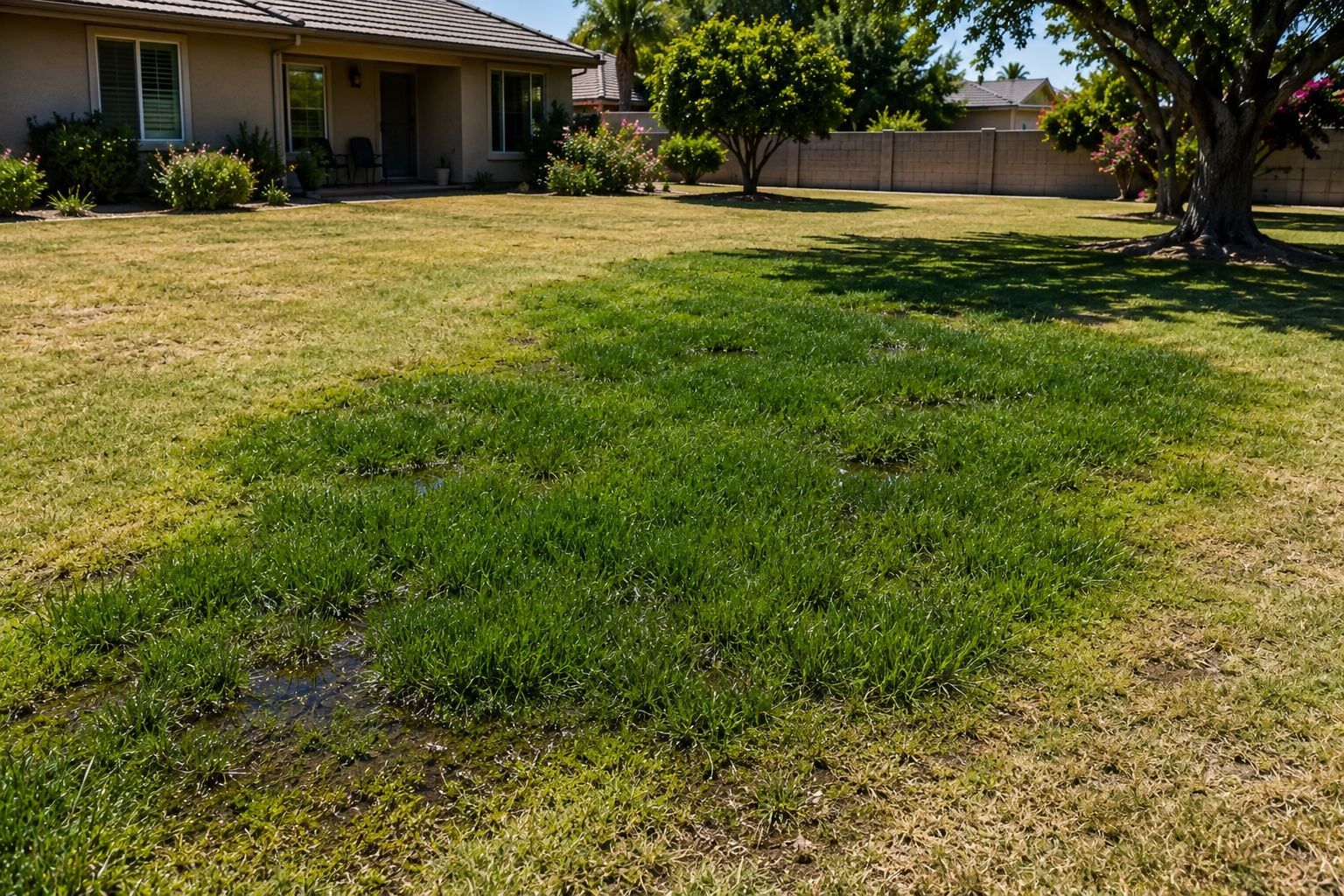
You noticed it a few weeks ago and you have been watching it since: a section of the yard that stays wetter than it should, a smell that comes and goes with the heat, maybe a toilet that drains just a little slower than it used to. Now you are trying to figure out whether this is something a repair crew can fix in a day or two, or whether you are looking at tearing out the whole drainfield and starting over. That question matters, because the answer changes everything about what happens next on your property.
Why This Question Doesn't Have a One-Size Answer
A leach field is not a single component that either works or doesn't. It is a system of trenches, gravel beds, distribution piping, and soil, all working together to accept effluent from the septic tank and let the ground filter it. Failure can start in any one of those pieces, and how far it has spread determines whether repair makes sense.
Some failures are mechanical and localized. A crushed pipe, a clogged distribution box, or a section of trench that has settled unevenly can choke off flow to part of the field while the rest keeps functioning. Fix the mechanical problem, and the field often goes right back to doing its job because the surrounding soil was never the issue.
Other failures are biological and gradual. Every leach field develops a biomat, a layer of organic material and microbial growth that forms naturally along the trench walls and gravel as effluent passes through. A thin, healthy biomat actually helps treatment. A biomat that has thickened over years of heavy use, or been fed by grease and solids that never should have reached the drainfield, eventually seals the soil surface underneath it. Once that seal covers the entire absorption area, water has nowhere left to go, and no amount of surface repair fixes what has happened below the gravel.
Still other failures come down to the soil itself. Desert ground across Maricopa, Pinal County, and the East Valley often has to work harder than soil in wetter climates because there is so little natural moisture passing through it to keep pores open. Add years of effluent loading, and the soil structure in the treatment area can compact and lose its ability to accept water, independent of anything happening in the trench above it.
Signs That Point Toward a Repairable Problem
Certain patterns tend to show up when the issue is contained rather than systemic. None of these guarantee a repair will hold, but they are the kind of clues that make restoration worth investigating first.
Symptoms Limited To One Section Of The Yard
If only part of the field's footprint shows standing water, unusually green grass, or odor, and the rest of the trench line stays dry and behaves normally, that pattern usually points to a localized mechanical or soil issue rather than complete field failure.
A Recent, Identifiable Trigger
A new addition to the household, a period of unusually heavy water use, a landscaping project that changed drainage near the field, or a known event like a root intrusion often explains a sudden change in performance. Fields that were working fine before a specific event and started struggling right after tend to respond better to targeted repair.
Slow, Gradual Onset Rather Than Sudden Total Failure
A field that has been slipping little by little over months, with drains getting incrementally slower, often still has usable soil capacity somewhere in the system. Total, sudden failure across the entire field points more toward an undersized system or a biomat seal that has been building for years and finally closed off the last of the working soil.
A Septic Tank That Is Doing Its Job
If the tank has been pumped and inspected and the effluent leaving it looks normal, that rules out one major variable and narrows the problem down to the trench, the soil, or the distribution system.
Signs That Point Toward Replacement
The opposite pattern shows up just as clearly once a technician gets a full picture of the field.
Symptoms Across The Entire Footprint
When every section of the trench line is showing the same signs, saturated soil, backups reaching the house regardless of which fixtures are running, or odor over the whole area, that usually means the whole absorption bed has lost capacity together, not just one segment of it.
A History Of Repeated Repairs In The Same Spot
A field that keeps needing the same fix every year or two is telling you the underlying soil or design problem was never actually solved. Each repair buys time rather than restoring long-term function.
A Field That Was Undersized From The Start
Some older systems were designed for smaller households or lower water use than the property now sees. In that case, restoring the existing trench only brings back a field that was never large enough for the load in the first place, and the same failure returns once usage climbs back up.
No Usable Soil Left In The Treatment Area
This is the finding that ends the conversation. When a test pit or soil evaluation shows the absorption zone has broken down structurally, compacted beyond recovery, or been sealed by biomat across its full depth and width, there is no repair that restores function in that same footprint. The only path forward is building a new field, sometimes in a different location on the property where the soil still has capacity.
How a Technician Actually Makes This Call
Deciding between repair and replacement isn't a guess made from the surface. It starts with digging.
Test Pits At Multiple Points
Opening the soil at several locations across the field, not just the spot that looks worst, shows how far the problem has spread and whether unaffected soil still exists nearby.
Camera Inspection Of The Distribution Lines
A camera run through the piping identifies crushed sections, root intrusion, or blockages that a repair can address directly, separate from whatever is happening in the soil.
Percolation And Absorption Checks In The Trench Itself
Watching how quickly standing water actually recedes in a test hole tells a technician whether the soil underneath is still accepting water at a usable rate or whether it has essentially stopped absorbing altogether.
A Review Of System Age And Design Against Current Household Load
A field's rated capacity and how long it has been in service both factor into whether a repair is worth pursuing or whether the system has simply reached the end of what it can support.
TIP:
Ask whoever evaluates your field to show you what they found in the test pit, not just tell you the conclusion. Seeing whether the soil looks dark and saturated, dry and structurally sound, or coated in a visible biomat layer gives you a much clearer sense of why repair or replacement is the right call, and it makes it easier to trust the recommendation.
What Restoration Looks Like When the Soil Still Has Capacity
When enough usable soil remains, restoring a field typically involves one or a combination of these approaches, matched to whatever the test pits revealed.
Clearing Lines And Correcting Distribution
If effluent has been loading unevenly across the trench because of a clog or a damaged distribution box, restoring even flow across the full field often brings dormant sections back into service.
Aerating And Loosening Compacted Soil
Where the soil structure has compacted but not sealed completely, mechanical aeration can reopen pore space and restore some absorption capacity without full excavation.
Rebuilding Trenches And Rock Beds
Replacing aged gravel and re-grading the trench bottom restores the physical structure the field relies on to distribute effluent evenly, which matters even when the surrounding soil itself is still sound.
Correcting Surface Drainage And Grading
Rainwater or irrigation runoff channeled onto the field adds load the system was never meant to absorb. Redirecting that water away from the trench can be enough on its own to bring a marginal field back to reliable performance.
Restoration work like this buys real time when the underlying soil is intact, but it depends entirely on that soil still being capable of doing its job. That is why the diagnostic step always comes first.
What Happens When Replacement Is the Right Call
When the evaluation shows the treatment area itself has failed, rebuilding in the same footprint usually just delays the same outcome. A new system gives the household a properly sized absorption area, built with current knowledge of the property's soil conditions rather than whatever assumptions went into the original design decades earlier. On lots where the old field's location turns out to be a poor fit for the soil across that section of the property, a new system can also be positioned somewhere with better absorption characteristics from the start, which does more for long-term reliability than repeatedly patching a location that was never going to hold up.
WARNING:
Continuing to use a septic system heavily while a field is already showing signs across its entire footprint raises the risk of effluent reaching the surface in larger volumes or backing up further into the house. If multiple areas of the yard are showing symptoms at once, or the tank itself is showing signs of strain, treat that as a signal to get an evaluation scheduled rather than waiting to see if it improves with lighter water use.
Frequently Asked Questions
How long does it typically take to know whether a field can be repaired?
Most evaluations provide an answer the same day after test pits and line inspections reveal soil conditions, drainage capacity, and whether the failure is localized or spread throughout the field.
If part of my field is fine and part has failed, can just the bad section be replaced?
Yes, a failed section can sometimes be replaced when damage is limited to one trench and inspections confirm the remaining field, soil, and distribution system continue functioning properly without problems.
Does the age of the septic system matter more than its symptoms?
No, symptoms and soil conditions matter more than age. Older systems may remain functional with proper maintenance, while newer fields can fail early because of poor sizing, installation, or soil.
Can I tell from the surface whether it's a repair or a replacement situation?
Not reliably. Wet areas, odors, or slow drains indicate trouble, but an underground inspection is necessary to determine whether damage is localized and repairable or widespread enough to require replacement.
Is it possible for a field to be partially restored now and fully replaced later?
Yes, partial restoration can extend a field's useful life when enough healthy soil remains. Later replacement may become necessary as absorption capacity declines or additional sections begin showing failure symptoms.
Knowing When Your Leach Field Needs More
A struggling leach field does not automatically mean the entire system has reached the end of its life. When usable soil remains and the failure is limited to damaged lines, uneven distribution, compaction, or drainage problems, targeted restoration can often return the field to dependable operation. With 25 years of experience, Simply Rooter and Septic understands how soil conditions throughout the Phoenix Metropolitan Area, AZ can influence whether repairing an existing field remains a practical long-term solution.
When the absorption area is saturated throughout, the soil has lost its treatment capacity, or the system was undersized from the beginning, replacement may provide the more reliable outcome. The important distinction comes from evaluating conditions below the surface rather than judging the field by wet grass, odors, or slow drains alone. Test pits, line inspections, and soil evaluations reveal how much functional capacity remains, allowing repair or replacement decisions to reflect the field's actual condition and expected performance over time.